Custom Web Development Services: How Novnodo Builds Sites
A slow page rarely announces itself. It shows up as a soft bounce rate and a demo form that nobody finishes. A visitor opens a SaaS pricing page, waits 3–4 seconds, and closes the tab.That is the real argument for custom web development services. A website is not a brochure. It is the system that turns traffic into trial signups, demo requests and revenue.
On an ecommerce site, a slow product page makes shoppers leave without adding to cart traffic comes in, but sales do not happen. At Novnodo, we have built 100+ sites for SaaS and ecommerce clients, and the process below is the one we use every time. On a SaaS client’s site, we fixed page speed and shortened the demo form, and demo requests became easier to track. On an ecommerce client’s site, we improved slow product pages and cart drop-offs went down. We’ll also tell you when you don’t need it.
Why Modern Enterprises Invest in Custom Web Development Services Over Off-the-Shelf Builders
Templates are quick to launch and slow to scale. Every plugin, widget and drag-and-drop block adds weight you can’t fully remove, and over time the platform’s limits become your growth ceiling.
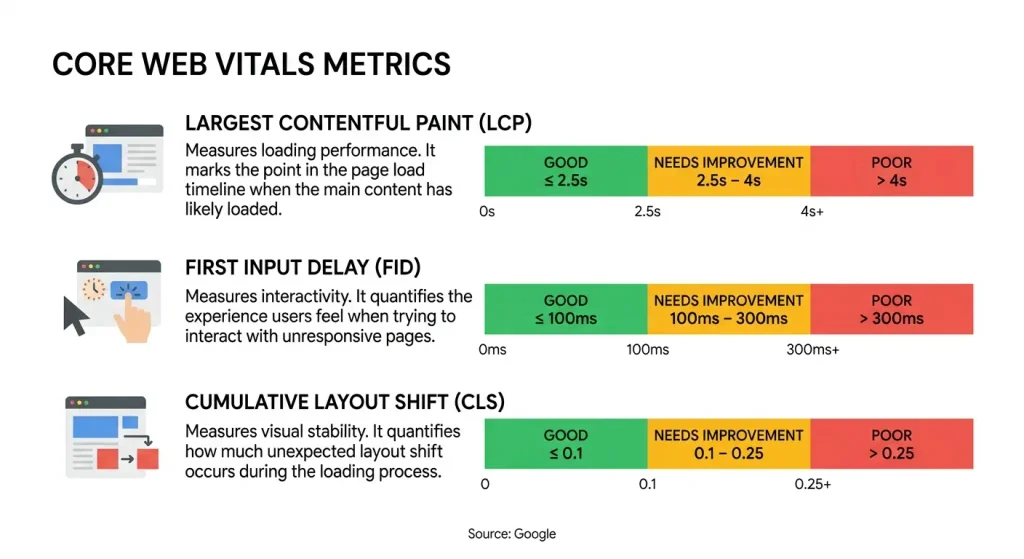
Speed is where it shows first. Google’s Core Web Vitals set the targets: Largest Contentful Paint under 2.5 seconds, Interaction to Next Paint under 200 milliseconds, and Cumulative Layout Shift under 0.1. On a heavy builder, hitting those is a constant fight. On a purpose-built stack, it is a design rule from day one.
The business case is well documented:
- In Google and Deloitte’s Milliseconds Make Millions study, a 0.1-second improvement in mobile site speed lifted retail conversions by 8.4%.
- Portent’s analysis found that B2B sites loading in one second converted about three times better than those taking five. (Verify the current figure before publishing.)
Speed is only half of it. Custom web development services also give you three things a builder cannot:
- Tighter security. Role-based access, hardened authentication, and no unvetted third-party scripts on your login or checkout pages.
- A data model that fits your product. Reporting on MRR, CAC and LTV comes straight from your database instead of a spreadsheet export.
- Direct integrations. Your CRM, billing system and analytics talk to the site through APIs, which makes pipeline attribution far more reliable.
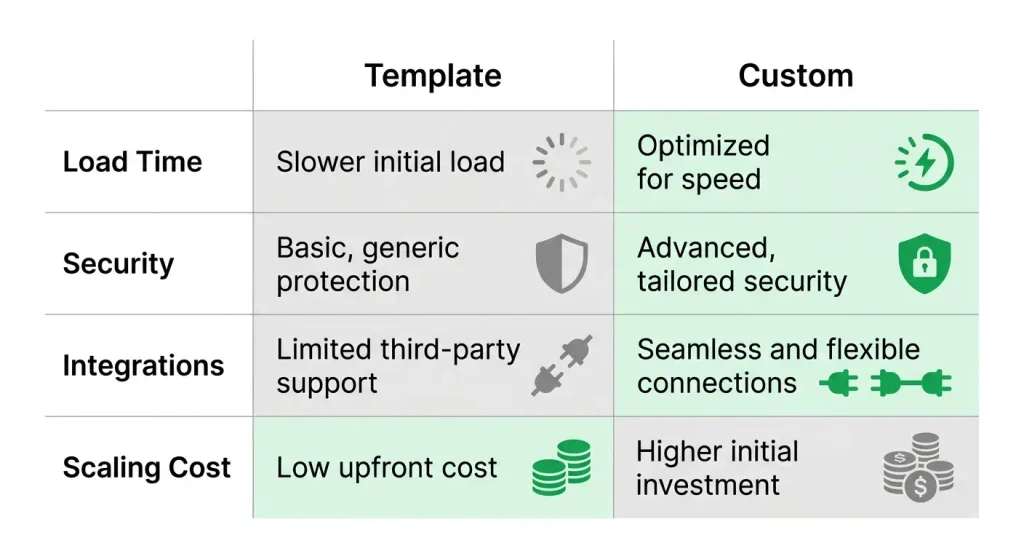
What this looks like in practice
A typical B2B SaaS pricing page loads in 4–5 seconds on mobile because of several embedded scripts. Visitors leave before it finishes loading, and demo requests stay low even when ad traffic is coming in. We rebuild the page with server-side rendering and a single analytics layer. In most cases, LCP drops under 2.5 seconds and trial signups improve within the first month.
When a template is the right call
Custom isn’t always the answer. If you’re validating an idea, running a site with fewer than about [10] pages, or have no budget for ongoing engineering, a well-configured template is often smarter. We’d rather tell you that on a first call than sell you a build you don’t need.
Get a Free Website Performance Audit →
What We Build and Maintain
Our custom web development services cover the full lifecycle, from the first build to the tenth year of upkeep.
WordPress, Custom Gutenberg Blocks and Headless CMS
WordPress powers a huge share of the web, and editors like it. The trouble starts when a site runs on a heavy theme and thirty plugins.
Our WordPress development services replace that stack with custom Gutenberg blocks, so your marketing team can assemble pages from approved components without touching code. When traffic or complexity grows, we can decouple the front end and run WordPress as a headless CMS, delivering content through its API to a React or Next.js front end.
Website Redesign Without Losing Your Rankings
A redesign that only changes colors is a repaint on a cracked foundation. Our website redesign services begin with an audit of your legacy code, your database and your search rankings, so the migration protects the organic traffic you’ve already earned.
We map every URL, set up 301 redirects, and rebuild on a modern, component-based architecture. The goal is a faster site that keeps its rankings and its history.
Maintenance and Uptime Monitoring
Launch day is the starting line. A store that works perfectly on launch week can still break in month three when a plugin update clashes with the checkout. Our web maintenance services include security patching, dependency updates, backups and uptime monitoring. When a payment gateway releases a new version, we update it before it breaks checkout. If a server goes down at 2 a.m., the site is restored from the last backup instead of losing orders. Alerts go to an on-call engineer, not a shared inbox. Your site goes down on a Saturday night — the engineer’s phone rings, not an email sitting unread until Monday. We acknowledge critical alerts within 30 minutes. If a client’s site goes down during a weekend sale, we confirm within 30 minutes that we are on it.
Step-by-Step Architecture: Delivering Custom Web Development Services From Wireframe to Launch
Every project passes through the same three stages, so nothing surprising reaches production.
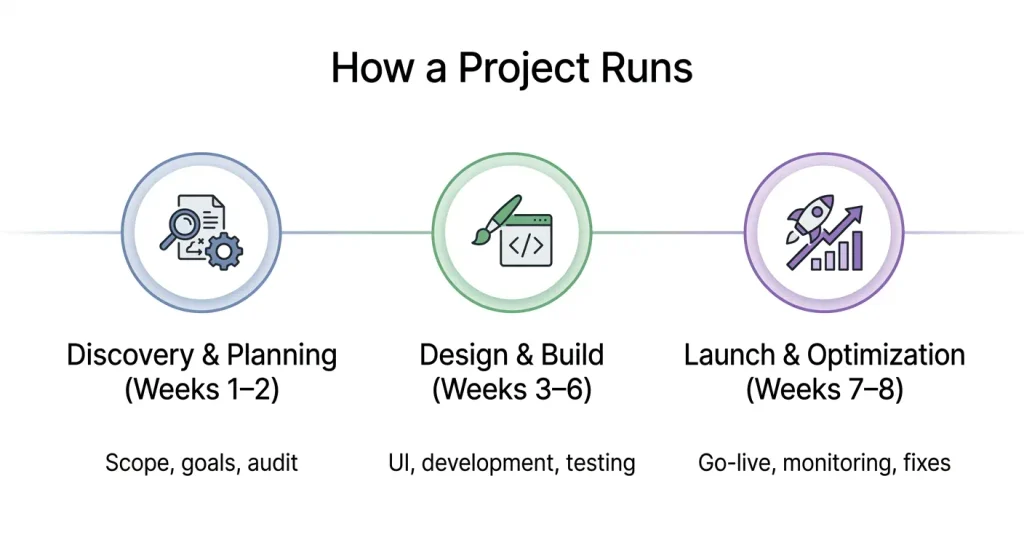
Step 1: Prototyping and a Reusable Component Library
We prototype in Figma before writing code. Stakeholders click through real flows, and we fix confusing ones while a change costs minutes rather than sprints.
Then we build a modular component library. A button, pricing card or form is coded once and reused everywhere, which keeps the codebase small and the pages fast.
Step 2: Designing for Your Stage
A five-person startup and a 500-seat SaaS company need different things. For small businesses, our web design services focus on clarity and speed to launch: a tight site that earns trust and captures leads.
For SaaS startups, we design around the funnel itself: pricing pages, trial-signup flows and onboarding screens, all instrumented so you can trace a visit to a signup to paid revenue.
Step 3: Quality Assurance and Cross-Browser Testing
We test on real devices across Chrome, Safari, Firefox and Edge, because a layout that works on one engineer’s laptop proves nothing. Accessibility checks against WCAG 2.2, Lighthouse audits and load testing happen before launch, not after the first complaint.
Skip this stage and you pay twice: once in lost conversions, again in emergency fixes.
Book a Web Architecture Strategy Call →
The Long-Term Payoff
The cheapest build is rarely the cheapest site. The real cost appears in year two, when every change takes a week.
Lower Technical Debt
Technical debt is interest on shortcuts. Builder-based sites build it up quietly through workarounds stacked on plugins, rarely documented.
We use typed code, automated tests and documented components, so a new engineer can ship a change in days. Version control and CI/CD pipelines make every release reviewed and reversible. Over time, this tends to make each new feature cheaper to build.
Conversion Gains You Can Measure
Design decisions should be answerable with numbers. We find where visitors drop off, then test one change at a time: a shorter form, a clearer headline, a faster pricing page.
For a SaaS site, the metrics that matter are trial signups, demo bookings and the CAC you pay to earn them. When speed, clarity and tracking work together, attribution gets cleaner, and the cost of each acquired customer often falls.
Partner with Novnodo for Scalable Custom Web Development Services
Your website is the one sales asset that works every hour of every day. If it’s slow, fragile or hard to change, it costs you more than any ad campaign saves.
Start with three checks. Run your key pages through PageSpeed Insights, review Core Web Vitals in Search Console, and list the three integrations your site lacks. That list is your brief. If you’d like a second pair of eyes, Novnodo’s custom web development team can turn it into a fast, secure platform your team can grow on.
Frequently Asked Questions
Answered by [Engineer Name], [Title], Novnodo
How long does a custom web development project take?
Most marketing sites take 8 to 12 weeks. Complex builds with custom databases, integrations or a headless CMS often take 12 to 20 weeks. Scope and how quickly feedback arrives affect the timeline more than anything else.
What is the difference between monolithic WordPress and headless architecture?
Monolithic WordPress handles content and front-end rendering in one system. Headless WordPress keeps the CMS for editing but delivers content through an API to a separate front end. The usual benefits are faster pages, a smaller attack surface and the freedom to reuse content across web and mobile. The trade-off is more engineering work and a higher build cost.
Do you provide maintenance and security patches after launch?
Yes. Our plans cover security patches, dependency updates, backups, uptime monitoring and a monthly performance review.
Can you integrate with our CRM and analytics stack?
Yes. We connect HubSpot, Salesforce, Stripe, GA4 and most tools with a public API, so lead and revenue data flows into one view.