B2B SaaS SEO Strategy to Scale Organic Demos & MRR
How We Built a Data-Backed B2B SaaS SEO Strategy to Scale Organic Demos & MRR
What if your SaaS website attracted thousands of visitors every month but generated only a handful of qualified demos? More traffic does not automatically mean more customers, and that is where a well-planned b2b saas seo strategy makes the difference.
At Novnodo, we approach SaaS SEO as a revenue-focused growth channel rather than a simple exercise in publishing blogs and building backlinks. The goal is to connect search intent with product value, attract decision-makers who are ready to evaluate solutions, and turn organic visibility into measurable business outcomes.
A sustainable strategy combines commercial keyword research, product-led content, technical SEO, and authoritative link building. When these elements work together, organic search can support qualified demo signups, improve customer acquisition efficiency, and contribute to monthly recurring revenue (MRR).
The Mechanics of a High-Converting B2B SaaS SEO Strategy: Traffic vs. Pipeline
Traditional SEO often prioritizes rankings, impressions, and total organic sessions. These metrics help diagnose performance, but they do not tell the complete story for a B2B SaaS company.
A visitor searching for “what is project management software” may be researching a concept. Another searching for “best project management software for enterprise teams” is more likely to be comparing solutions.
Both searches have value, but their commercial intent differs significantly.
Why Traditional SEO Tactics Fail for B2B SaaS
Publishing generic informational articles can generate traffic without attracting people who need your product. Similarly, acquiring backlinks from unrelated websites may increase referring domains without improving topical relevance or qualified conversions.
The problem is not blogging or link building themselves. It is using them without a clear connection to the buyer journey.
Our approach is to map keywords to business objectives:
- Awareness: Help potential customers understand their problem.
- Consideration: Explain approaches, features, and available solutions.
- Decision: Target searches involving software comparisons, alternatives, pricing, and integrations.
- Conversion: Direct qualified visitors toward a demo, free trial, or sales conversation.
This intent-based structure makes SEO more accountable. Instead of asking only how much traffic a page attracts, ask how many qualified opportunities it creates.
For example, a page attracting 300 monthly visitors with a strong commercial intent may be more valuable than a blog receiving 5,000 visits but generating no product-qualified leads. These figures illustrate the principle, not a reported Novnodo campaign result.
Want to identify backlink opportunities that support commercial SEO pages?
Get a Free Link Building Audit
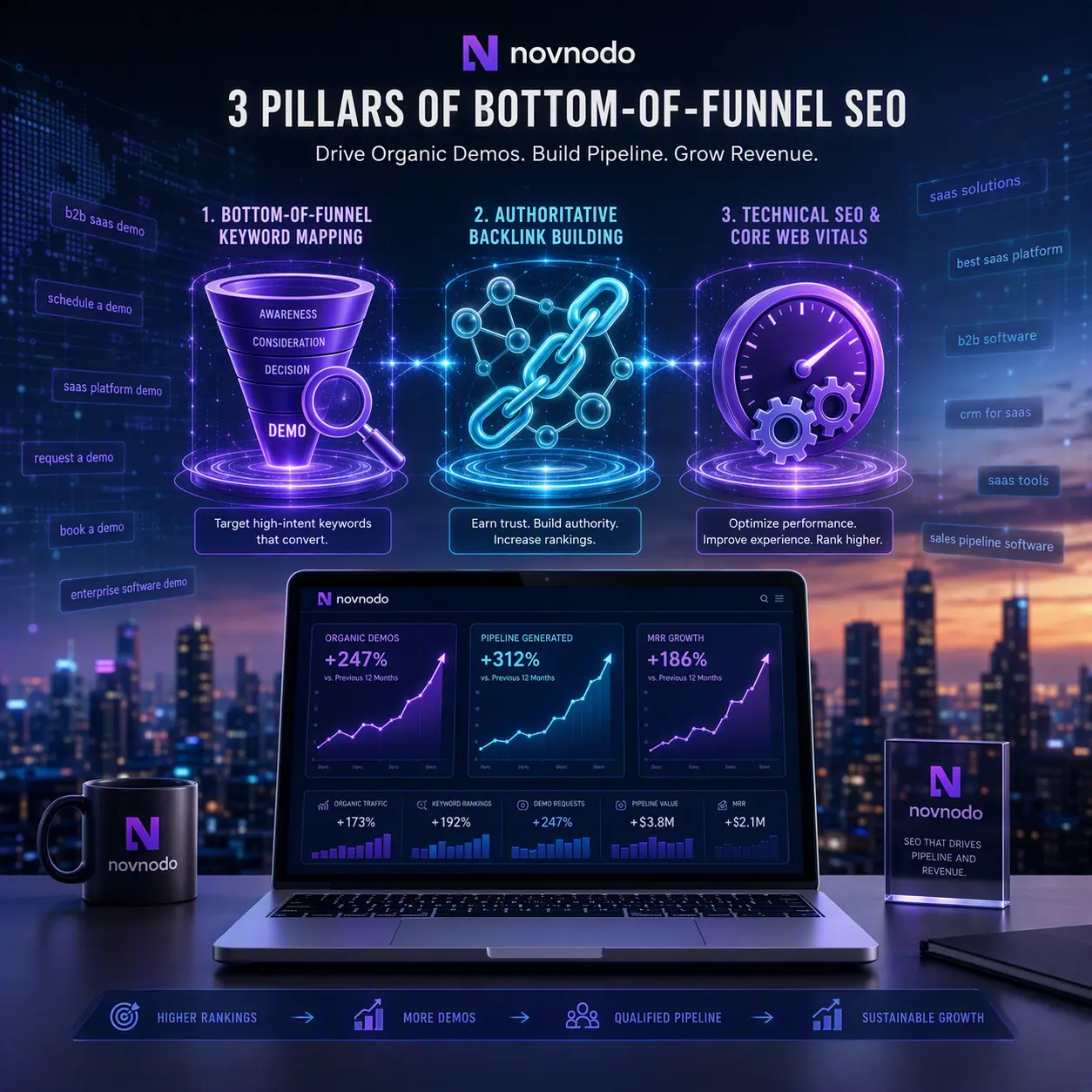
The 3-Pillar Framework We Use at Novnodo for SaaS Organic Growth
A strong SaaS marketing strategy should align search visibility with the product, the audience, and the company’s revenue model. We organize organic growth around three connected pillars.
1. Bottom-of-Funnel (BOFU) Product-Led Keyword Mapping
BOFU keywords reveal what buyers search for when they are close to making a decision. Examples include “CRM software for SaaS startups,” “[Product] alternatives,” and “automated reporting software with Salesforce integration.”
These searches provide opportunities to demonstrate how a product solves a specific business problem.
We map each keyword to the most appropriate landing page instead of forcing every term into a blog post. Comparison queries deserve comparison content, while integration queries should lead to pages explaining the integration’s actual capabilities.
A useful rule: the page should satisfy the search intent before it asks for the conversion.
Include relevant use cases, product screenshots, implementation details, limitations, and clear calls to action. This helps buyers evaluate the product while giving search engines a clearer understanding of the page.
2. Securing DR50+ Contextual Link Insertions & Editorial PR
Backlinks can strengthen a SaaS website’s authority when they come from relevant, credible publications. However, Domain Rating (DR) is a third-party metric, not a Google ranking factor.
At Novnodo, our recommended link-building approach prioritizes editorial relevance, real website quality, and contextual placement over a DR threshold alone.
For example, a cybersecurity SaaS company may benefit from a relevant mention in an established technology publication more than a link from a high-DR website covering unrelated topics.
Effective link acquisition can include:
- Contextual link insertions in existing, relevant articles.
- Editorial guest contributions that provide genuine reader value.
- Digital PR campaigns based on original research or useful industry insights.
- Relationship-driven outreach to publishers and subject-matter experts.
We also assess referring-domain quality, organic visibility, outbound-link patterns, and editorial standards before recommending opportunities.
The objective is not simply to acquire more links. It is to build a credible backlink profile that supports the pages most likely to influence qualified leads.
3. Technical Site Architecture: Core Web Vitals & Speed Optimization for Web Apps
Technical problems can prevent otherwise valuable content from performing well. SaaS websites face particular challenges when they rely on JavaScript-heavy interfaces, dynamic URLs, complex navigation, or client-side rendering.
We recommend auditing crawlability, indexation, canonical tags, XML sitemaps, internal links, structured data, and mobile usability before scaling content production.
Core Web Vitals provide additional insight into user experience:
- LCP: Measures loading performance.
- INP: Measures responsiveness to user interactions.
- CLS: Measures unexpected layout shifts.
Google’s current good-performance thresholds are LCP at 2.5 seconds or less, INP at 200 milliseconds or less, and CLS at 0.1 or less, measured at the 75th percentile.
Meeting these thresholds does not guarantee rankings, but improving them can create a smoother experience for visitors evaluating your product.
Step-by-Step Execution: Building Your B2B SaaS SEO Strategy from Real Campaign Data
A successful b2b saas seo strategy needs a repeatable process for deciding what to prioritize, how to execute, and which outcomes to measure.
The following workflow is designed around campaign data and established SEO practices. It is a practical framework, not a claim that Novnodo achieved a particular growth percentage for a named client.
Step 1: Identify High-Intent Commercial Terms Over High-Volume Queries
Start with Google Search Console, keyword research tools, competitor analysis, and customer-facing teams.
Look for searches that indicate a problem your product solves. Review existing rankings, impressions, click-through rates, landing-page conversions, and the quality of leads generated by each page.
A keyword with modest search volume can deserve priority if it attracts the right decision-maker. Conversely, a high-volume keyword may have limited business value if its audience is unlikely to become a customer.
Prioritize opportunities using four factors:
- Relevance to the product and ideal customer profile.
- Commercial intent and proximity to purchase.
- Ranking feasibility based on competition and existing authority.
- Potential contribution to qualified pipeline and revenue.
This process prevents content teams from chasing search volume at the expense of business outcomes.
Step 2: Deploy B2B SEO Solutions Across Core Feature & Integration Pages
Your feature and integration pages often sit closer to revenue than general educational content.
Suppose a SaaS company offers automated reporting, CRM synchronization, and workflow management. Each capability can support a dedicated landing page if it solves a distinct user problem and offers enough unique information.
Build pages around meaningful use cases, not minor keyword variations. Explain what the feature does, who benefits from it, how it works, and what users need to implement it.
For integration pages, include supported functionality, setup requirements, practical workflows, and limitations where relevant.
These b2b seo solutions give searchers specific answers while helping sales teams direct prospects toward the most relevant product capabilities.
Internal links should connect educational content to feature pages, integration pages, comparisons, and conversion points. Use descriptive anchor text naturally rather than repeating exact-match keywords everywhere.
Step 3: Scale Domain Authority Through Transparent White-Hat Outreach
Once your important commercial pages are in place, build a link acquisition plan that supports them.
A b2b saas seo agency should be able to explain where links come from, why a publication is relevant, and how placements are evaluated. Transparency matters because poor-quality link schemes can create risk without delivering sustainable value.
Create linkable assets such as original surveys, benchmark reports, expert commentary, and practical research. Then approach relevant publishers with a clear editorial reason to reference the material.
Contextual link insertions can also be useful when an existing article genuinely benefits from referencing your resource. Avoid irrelevant placements, undisclosed paid links that violate search-engine spam policies, and networks designed primarily to manipulate rankings.
Review referring domains, organic landing-page performance, qualified demos, and assisted conversions over time. This provides a stronger picture than counting acquired backlinks alone.
Ready to build a more relevant backlink profile for your SaaS website?
Book an Outreach Strategy Call
Scaling Beyond Basics: Enterprise SaaS SEO & Multi-Region Expansion
As SaaS companies enter new markets, their SEO requirements become more complex. Enterprise SaaS SEO requires consistent technical governance, international targeting, and scalable content quality.
Managing International SEO Architecture: Hreflang Tags & Subfolders
International expansion should reflect how customers search and buy in each market. Translating an English landing page is not always enough; terminology, search intent, regulatory requirements, and product availability may differ.
For example, a company targeting the United Kingdom, Germany, and France might use localized subfolders such as /en-gb/, /de-de/, and /fr-fr/.
Use hreflang annotations to help search engines understand language and regional page relationships. Each localized version should reference the relevant alternatives, including itself, with valid reciprocal annotations.
Also review canonical tags, XML sitemaps, internal links, and local conversion paths. Avoid automatically redirecting every visitor based on IP address, as this can interfere with users and search-engine crawling.
Scaling Programmatic Feature Pages Without Thin Content
Programmatic SEO can help SaaS companies target large sets of legitimate use cases, integrations, industries, or workflows.
However, generating hundreds of pages from a spreadsheet does not automatically create organic value.
Each page should serve a distinct search need and include useful, specific information. An integration page, for instance, could explain available data flows, setup instructions, automation examples, and common troubleshooting steps.
Before publishing at scale, assess whether each page offers something meaningfully different from existing pages. Consolidate overlapping content, remove empty templates, and prevent low-value URLs from being indexed unnecessarily.
The goal is scalable usefulness, not simply scalable publishing.
How We Measure Success: Auditing Your B2B SaaS SEO Strategy for CAC Reduction
SEO reporting becomes more useful when it connects search performance to customer acquisition.
We recommend building a measurement framework that follows the journey from organic search to qualified lead, sales opportunity, and closed customer.
Track these metrics together:
| Metric | What it tells you |
| Organic non-brand clicks | Whether search visibility is expanding beyond existing brand demand |
| Organic demo conversion rate | How effectively landing pages turn visitors into demo requests |
| Marketing-qualified leads (MQLs) | Whether organic acquisition attracts relevant prospects |
| Sales-qualified opportunities | Whether those prospects meet sales criteria |
| Organic-sourced pipeline | The potential value of opportunities attributed to organic acquisition |
| Organic-sourced MRR | Recurring revenue from customers attributed to organic search |
| Organic CAC | The cost of acquiring customers through organic search |
Connect Search Data to CRM Outcomes
Google Search Console shows search performance, while GA4 helps analyze website interactions and conversion events. A CRM such as HubSpot can connect lead records with sales stages and closed-won revenue.
Use consistent campaign definitions, conversion events, and CRM lifecycle stages. Capture original and latest traffic sources where possible, and document your attribution model.
For example, a prospect may discover a product through organic search, return through a branded search, and book a demo after reading a comparison page. Last-click reporting may credit only the final interaction, hiding the contribution of earlier organic visits.
Compare first-touch, last-touch, and multi-touch views where your tracking setup supports them. Treat attribution as an informed model rather than definitive proof that one channel caused every sale.
To estimate organic CAC, divide the agreed organic acquisition costs by the number of new customers attributed to that channel over the same period. Include relevant content, technical SEO, agency, and outreach costs, and account for the delay between investment and customer acquisition.
When qualified organic acquisition grows while costs remain controlled, SEO can contribute to lower blended CAC over time. Results depend on sales cycles, competition, conversion rates, retention, and customer lifetime value (LTV).
Frequently Asked Questions (Answered by Our Lead SEO Strategists)
1. How do we accurately measure organic demo attribution in HubSpot and Google Analytics 4?
Configure demo submissions as conversion events in GA4 and use consistent source and medium tracking. Connect website activity with HubSpot contact records and lifecycle stages where possible. Compare first-touch, last-touch, and multi-touch attribution, and reconcile the results with actual CRM opportunities and closed-won revenue.
2. Why does general blogging fail for SaaS compared with product-led SEO?
General blogging can attract visitors who have no immediate need for the product. Product-led SEO targets feature, integration, comparison, and use-case searches that align more closely with buyer requirements. The strongest strategy combines both approaches and gives every content asset a clear purpose.
3. How long does it take for high-authority white-hat backlinks to impact demo conversions?
There is no guaranteed timeline. Relevant backlinks may support discovery and ranking improvements over several weeks or months, but the outcome depends on competition, existing authority, page quality, crawling, and search intent. Demo conversions may take longer to change and should be tracked separately from ranking improvements.
4. What makes a B2B SaaS SEO strategy different from traditional SEO?
It connects keyword targeting, content, technical improvements, and link acquisition to the SaaS buying journey. Success is measured through qualified leads, opportunities, customer acquisition costs, and recurring revenue, not traffic alone.
5. Is enterprise SaaS SEO different from SEO for smaller SaaS companies?
Yes. Enterprise programs often involve larger websites, international markets, complex integrations, multiple stakeholders, and stricter technical governance. They require scalable processes without compromising localization, indexation, or content quality.
6. How should a SaaS company choose a b2b saas seo agency?
Look for a partner that understands SaaS buyer journeys, commercial keyword mapping, technical SEO, relevant link acquisition, and CRM-based measurement. Ask how it reports qualified demos and pipeline, evaluates backlink quality, and distinguishes verified campaign results from forecasts.
Build an SEO Strategy That Supports Revenue, Not Just Rankings
A sustainable b2b saas seo strategy starts with a simple principle: attract the right audience, provide the right information, and make the next step clear.
For Novnodo, the practical path is to prioritize commercial search intent, strengthen feature and integration pages, improve technical foundations, and earn relevant editorial links. Then connect organic activity with CRM outcomes to understand which investments contribute to qualified demos and MRR.
Start by auditing your highest-value landing pages, identifying commercial keyword gaps, and reviewing the quality of your existing backlink profile. Build from evidence, measure consistently, and invest in the activities that support your business goals.