
International SEO Services for B2B Brands | Novnodo
How We Deliver International SEO Services for B2B Brands
Global Growth Takes More Than Translation
Entering a new country can double your addressable market. It can also double your SEO problems if your website isn’t ready.
For B2B brands, traffic alone isn’t the goal. Sales cycles are long, buying committees are large, and a visitor from Munich expects different proof, pricing, and compliance details than a visitor from Manchester.
Language matters here more than many teams assume. CSA Research’s “Can’t Read, Won’t Buy” series, whose most recent edition is based on surveys fielded in late 2019 and early 2020, found that 76% of online shoppers prefer to buy when product information is in their own language, and 40% say they won’t buy from sites in other languages. The B2B side points the same way. CSA’s analysis of 1,116 business buyers found a long-running preference for localized products, even when they cost more. It also found that countries with strong English skills, such as Germany and Sweden, were among the most committed to getting content in their own language. These figures are several years old, so treat them as directional rather than a current market measurement.
At Novnodo, we treat international SEO as a growth strategy, not a localization project. We combine technical SEO, local keyword research, localized content, relevant backlinks, and conversion tracking. Every decision ties back to a business goal: demo requests in Germany, enterprise leads in the UK, or qualified traffic across North America.
Choosing the Right Site Architecture
How you structure regional pages affects how search engines read them and how easily your team can maintain them. Changing structure after launch is expensive, so decide early.
Subdirectories, ccTLDs, or Subdomains?
Most international B2B sites choose one of three setups:
- Subdirectories: example.com/uk/, example.com/de/
- Country-code domains (ccTLDs): example.co.uk, example.de
- Subdomains: uk.example.com, de.example.com
Subdirectories are usually our starting point for growing SaaS brands. Everything sits on one domain, so regional pages benefit from authority you’ve already earned, and you run one CMS, one analytics setup, and one internal linking structure. The trade-off, which Google’s own documentation also lists, is that separating sites is harder with subdirectories.
ccTLDs give the clearest local signal and make a brand feel native in a market. The cost is real: each domain needs its own authority, backlinks, and upkeep. They make sense when you have local teams, local legal entities, and budget to run each country as its own business. One detail catches people out: Google treats any top-level domain that isn’t officially a country code as a generic one, and regional domains like .eu and .asia count as generic too.
Subdomains sit in the middle. They suit regional sites that run on different platforms or teams, but many SEOs see them as semi-separate from the main site, so authority doesn’t always carry over as smoothly.
We choose by asking three questions:
- How strong is your existing domain?
- Do you have in-market teams and budget for separate sites?
- How different do offers, pricing, or compliance rules need to be in each country?
Avoiding Duplicate Content Across Regions
International sites often end up with near-identical pages. A US pricing page and a UK pricing page may share most of their copy and differ only in currency.
This isn’t automatically a penalty. Google’s guidance on localized versions says they only count as duplicates when the main content stays untranslated. The real risk is confusion: if your signals are unclear, Google may show US pricing to a UK searcher.
Two habits prevent that:
- Make each market page genuinely different where it matters. Localize pricing, currency, spelling, regulations, customer examples, availability, and calls to action. Google also notes that local addresses and phone numbers, local currency and language, and links from local sites all help signal your intended audience.
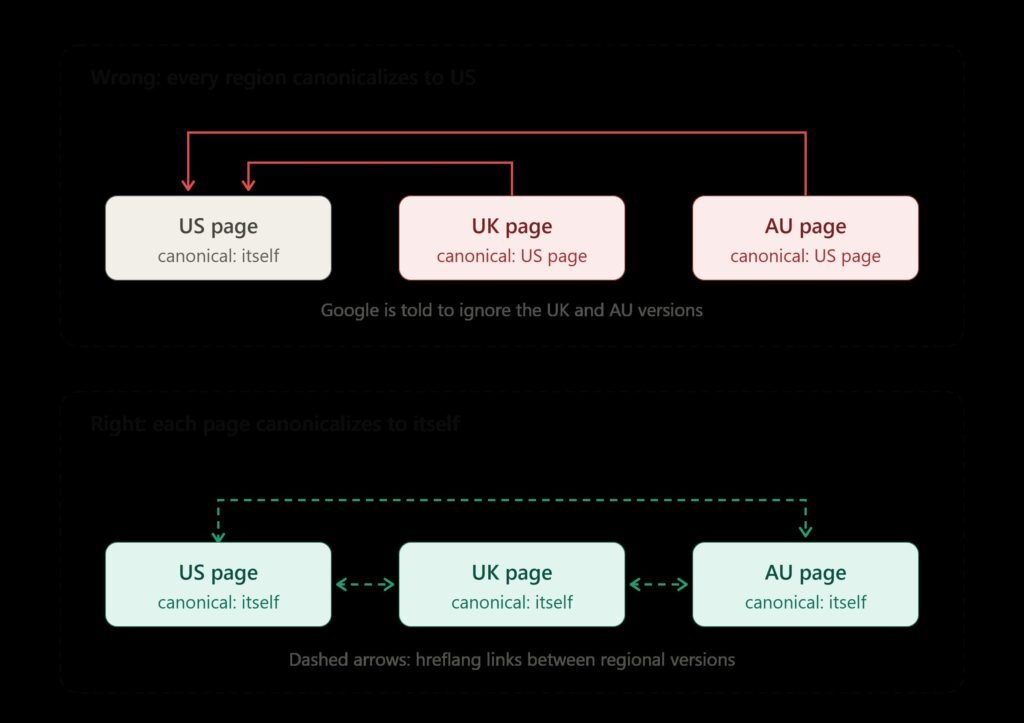
- Use canonicals and hreflang together. For similar same-language pages on different URLs, Google’s advice is to pick a preferred version and use rel=”canonical” plus hreflang so the right regional URL reaches searchers. The most common mistake we see is pointing every regional canonical at the US page, which tells Google to ignore the other regions. Each regional page should normally canonicalize to itself.
You don’t need to rewrite every sentence. You need each page to be useful to the person searching in that market.
Not sure your regional pages send the right signals? Book an international SEO strategy call and we’ll review your setup.
Technical Foundations: Our International SEO Checklist
A good strategy fails when technical signals contradict it. Before any market launch, we check architecture, indexability, language annotations, and performance.
Hreflang and Language Targeting
Hreflang tells Google which language or regional version suits which user. A reliable setup includes:
- Valid language codes, plus region codes where relevant (en-gb, de-de).
- Reciprocal references. Google’s documentation states that each language version must list itself and all the other versions.
- Canonical tags that match each page’s own URL.
- An x-default fallback, which Google describes as a way to send users who match none of your versions to a generic page, such as a language selector.
Hreflang is a signal, not a command. Google may still show a different version if it judges that better for the searcher.
The errors we meet most often are missing return links, wrong codes, and hreflang pointing at redirected or non-indexable URLs. Wrong codes are especially common. A region on its own (like “GB”) is invalid, and a country code used as a language code (like “UK” instead of en-GB) is a classic mistake. Also pick one place to declare hreflang (HTML, headers, or sitemap) rather than mixing them. On large sites, one template bug can break thousands of URLs, so we validate before launch and monitor afterward.
Running an International SEO Audit Before Launch
An international SEO audit answers one question: can search engines crawl, index, and correctly interpret every market’s content? We check:
- Indexability: Are important regional URLs crawlable and indexable?
- Canonicalization: Do canonicals point to the intended pages?
- Hreflang: Are annotations valid and reciprocal?
- XML sitemaps: Do they list the right URLs, free of redirects and errors?
- Internal linking: Can users and crawlers find regional alternatives?
- Content quality: Does each market get genuinely useful, localized content?
- Performance: Do pages load reliably for international visitors?
- Conversion tracking: Can you measure regional leads and demo requests?
We use Google Search Console, Google Analytics 4, Screaming Frog, and Ahrefs, each covering different parts of the job.
The output matters more than the tool. A spreadsheet of 400 warnings helps nobody. A prioritized plan does. Fixing a canonical issue that keeps key pages out of the index will almost always beat polishing a minor metadata inconsistency, so we rank every finding by business impact and effort.
Geo-Targeting in Search Console, and What CDNs Do
Older guides tell you to set a target country in Search Console. That option is gone. Google’s Help Center states that the International Targeting report is deprecated, hreflang is still supported, and country targeting through Search Console was judged to have little value. The report was scheduled for removal on September 22, 2022. Search Console still gives you country-level performance data, so you can see how each market performs, but you can’t assign a country to a generic domain anymore.
So regional relevance now comes from clear URL structure, hreflang, localized content, and sensible internal links.
A content delivery network (CDN) speeds up your site by serving assets closer to users. It doesn’t tell Google which country you target, and it doesn’t guarantee rankings. Its value is performance, and performance still matters. Google’s current Core Web Vitals “good” thresholds are LCP at or under 2.5 seconds, INP at or under 200 milliseconds, and CLS at or under 0.1, judged at the 75th percentile of real-user data. INP replaced FID in March 2024, so any guide still talking about FID is out of date. Check these numbers for each market you serve, because a slow pricing page loses demo requests even when rankings look healthy.
Step-by-Step Growth: From Foundations to Pipeline
Technical foundations make your site accessible. A market-specific strategy attracts buyers who are ready to evaluate you.
Step 1: Build a Keyword Strategy for Each Market
Start with customer intent, not translations of your existing keyword list.
Take a project management software company. US buyers search “project management software.” German buyers may use different terminology, compare features that matter locally (like data hosting location and GDPR compliance), and trust different review sources. A literal translation misses all of that.
For each market, we research:
- Regional search demand and keyword difficulty.
- Local terminology and how competitors position themselves.
- The mix of commercial, informational, and product-led intent.
- Industry language and buyer expectations.
- Opportunities tied to demos, trials, and enterprise evaluations.
We also read the actual search results in each country. If the top results are comparison pages and local review sites, a product page alone won’t compete. Then we map keywords to relevant landing pages instead of building a page for every variation, which only creates thin pages that compete with each other.
Step 2: Localize Content, Not Just Language
Translation changes words. Localization changes the experience. For B2B, that usually means:
- Case studies and logos from the same region, when you have them.
- Local compliance and data-handling information (GDPR for the EU, for example).
- Pricing in local currency, with local payment and invoicing terms.
- Local contact details, support hours, and time zones.
- Examples and terminology that read as native, reviewed by a native speaker with industry knowledge.
Machine translation can speed up a first draft, but don’t publish it unreviewed on pages that drive revenue. A badly worded pricing or security page costs trust you’ve worked hard to earn.
Step 3: Build Regional Authority
Backlinks from relevant local sites reinforce your regional relevance, and Google lists links from other local sites among its audience signals. We focus on industry publications, local partners and integrations, regional events and associations, and customer mentions in the target market. One relevant link from a respected local trade site is worth more than a pile of generic directory links.
Step 4: Measure Pipeline, Not Just Traffic
Set up tracking before launch, not after. Per market, track organic sessions, demo requests and trial sign-ups, lead quality, and pipeline created. In GA4, segment by country and language so you can tell whether German visitors are converting or just browsing. Review results monthly, and give a new market several months before judging it, since B2B cycles are long.
Conclusion
International SEO comes down to three decisions: a site structure that fits your business, technical signals that don’t contradict your targeting, and a keyword and content strategy built around each market’s buyers. Get those right, and regional visibility turns into qualified pipeline.
If you’re planning a launch into a new market, book an international SEO strategy call and we’ll show you where your current setup helps or hurts.
FAQ
Do I need a ccTLD to rank in another country?
No. Subdirectories on a generic domain can work well when combined with hreflang, localized content, and local signals. ccTLDs give a clearer local signal but cost more to run.
Is hreflang required?
It isn’t mandatory, but without it search engines have to guess which version to show. For multi-regional B2B sites, we consider it essential.
Can I still set a target country in Search Console?
No. Google deprecated the International Targeting report, as noted above.
Will similar pages across regions get me penalized?
Not automatically. The risk is the wrong version showing up. Localize each page and use canonicals and hreflang correctly.
How long does international SEO take?
It depends on your domain strength, competition, and market.